I planted a young kousa dogwood in my front yard after admiring a row of blooming ones near a parking lot in Berkeley Heights. The white bracts looked proper and sweet—it was the sort of ornamental tree that would soften my small suburban lawn without overwhelming it.
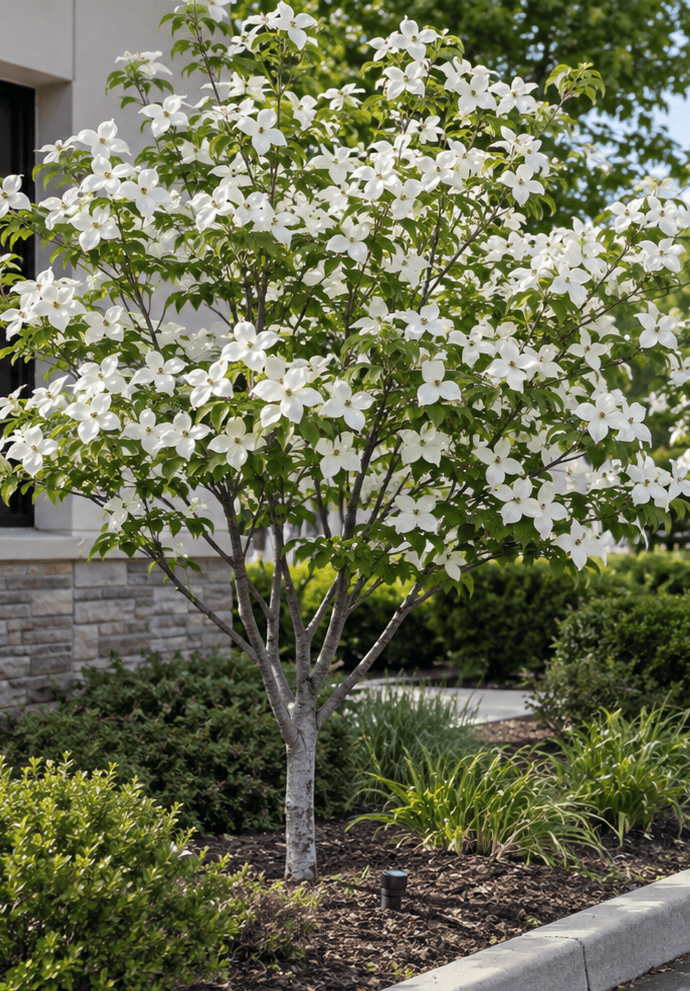
Illustration generated with ChatGPT.
The spot looked right: part sun, dappled shade, decent soil, and I had a place where I could see it from the bay window of my home. I watered the tree, watched it settle in, and imagined the future version—a round little tree, maybe ten feet tall, covered in white flowers each spring.
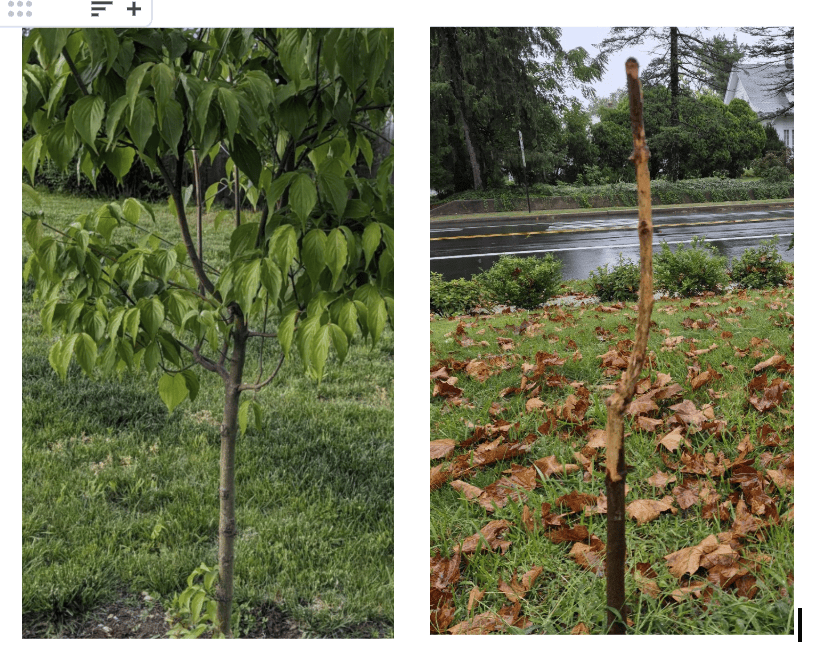
My kousa dogwood before and after the damage.
Months later, I woke up – not to a young tree reaching toward the sky – but to a single stick protruding from the ground. The branches and leaves were scattered across the wet grass. At first I blamed the weather. Then I thought of the groundhog that had raided my tomatoes years ago. Then a neighbor mentioned seeing a very large male deer on our street that evening.
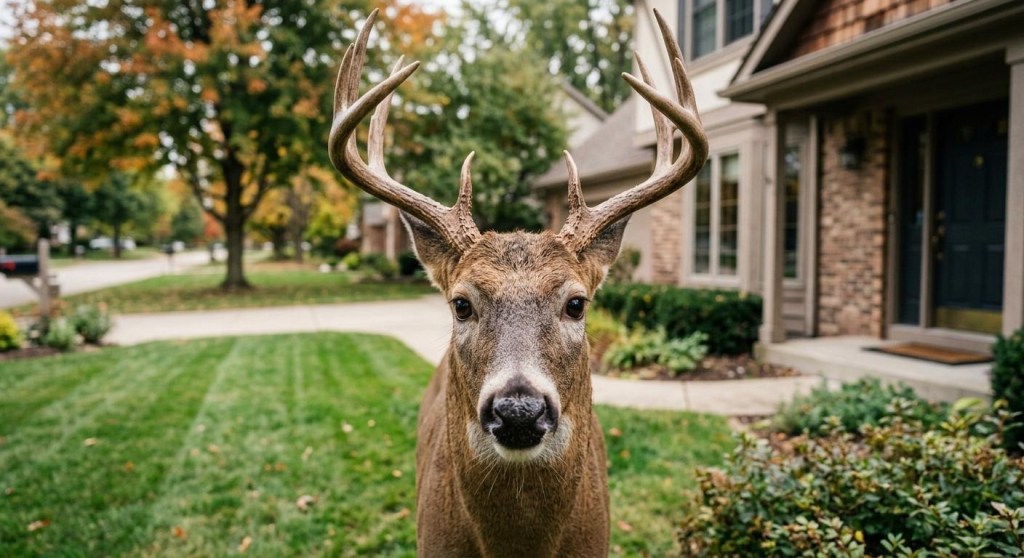
It had to have been the buck. The damage matched what Penn State Extension describes as antler-rubbing damage. In late summer, bucks break branches and strip bark from young trees in an effort to scratch the velvet off their itchy antlers.
I was incensed.
I had hauled that tree home from Home Depot, dug the huge hole, watered it through summer, and spent real money on it. In my mind, the buck was a brute—an intruder with no respect for property lines and with no manners at all.
My reaction was hardly unique to me.
When wildlife damages something we value, our first instinct is often anger, fear, or a demand that somebody make the animal stop. In Cape Town, baboons entering neighborhoods have provoked exactly that kind of response.
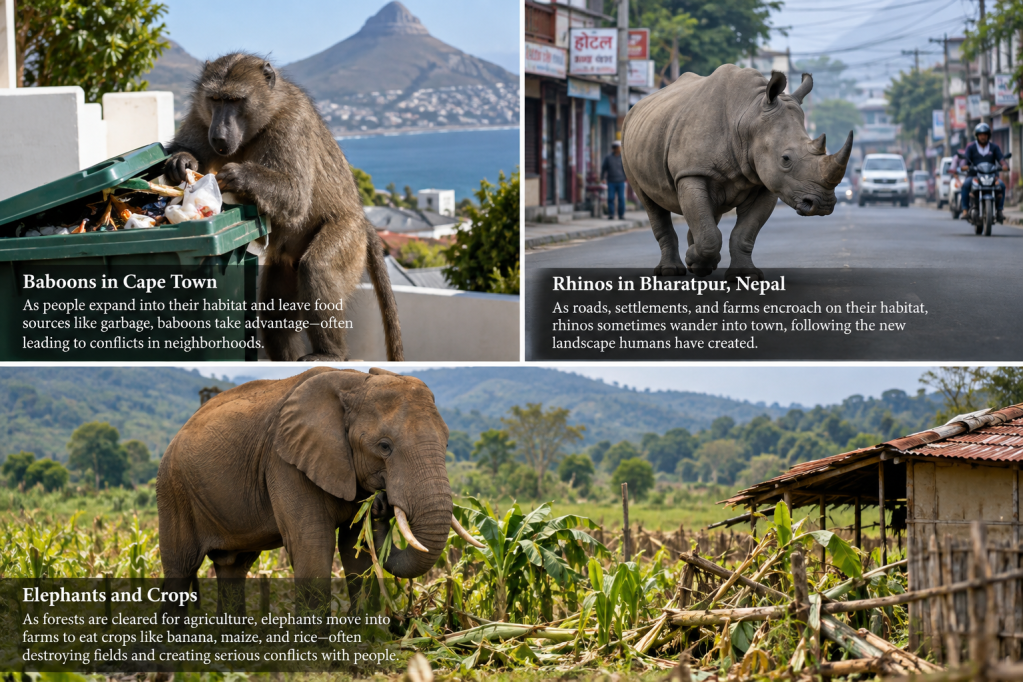
Illustrations of three human-wildlife conflicts discussed below. Generated with ChatGPT.
Residents have described the fear, anger, and distress that accompanied encounters with baboons. In response to instances where animals raid homes, bins, and gardens or damage property, authorities have operated programs specifically designed to keep “raiding” baboons out of residential areas. (SANParks)
Farmers in eastern Thailand have had an equally understandable reaction to elephants entering their fields. Elephants damage bananas, jackfruit, coconuts, mangoes, and other crops, threatening both property and livelihoods. Researchers found that people living in areas with the most crop raiding became less tolerant of elephants. Some wanted the animals moved back into protected areas; others called for elephant sanctuaries or population-control measures. (Nature)
In Bharatpur and the communities around Chitwan National Park in Nepal, the presumption is that the rhinos are creating the problem. Residents report avoiding certain routes and routines because rhinos increasingly appear near homes and streets. Local concerns have been raised at municipal hearings, and the danger is not hypothetical: eight people were reported killed by rhinos in the park’s buffer zone and nearby settlements during the previous fiscal year. (Kathmandu Post)
In these instances, people viewed the baboons as raiders, the elephants as thieves, and the rhinos as intruders, just as I viewed the buck as an invader. In each of these examples, the language begins with the assumption that the animal has crossed a boundary it should have respected.
But the story is more complicated than that.
Before the animal crossed these boundaries, humans had taken measures that changed its world. I had planted the tree under the notion that the yard belonged to me only.
- Much of the productive land in the Cape Peninsula has been converted into residential, commercial, industrial, and agricultural development, which left the baboons without access. (Cape Nature)
- Between 2000 and 2020, researchers found that the suitable elephant range in the study area declined from about 9,534 square kilometers to 4,850, while agriculture, plantations, infrastructure, and other land uses altered and fragmented the landscape. (Nature)
- Before rapid settlement and deforestation beginning in the 1950s and 1960s, the Chitwan Valley Nepal contained roughly 2,600 square kilometers of continuous forest and grassland; more than 70 percent was subsequently cleared as human settlement expanded. (Kathmandu Post)
In these instances, the animals did not initiate the change. Humans altered the landscape first, and the consequent disruptions were attempts by the animals to adjust to the changed environment.
The damage to human settlements in these examples is far more extensive than mine. People have lost food, income, property, and sometimes, even their lives. But the human response is the same: we tend to notice the moment that an animal crosses a boundary, but we neglect to recognize the way in which we moved the boundary first.
A baboon should stay out of the kitchen. An elephant should stay out of a field. A rhino should stay out of a street. That buck should have left my dogwood alone. All of those expectations make perfect sense from a human point of view, but there is a problem when we assume wildlife must do all of the adapting.
Coexistence works when adaptation runs in both directions; there’s evidence to suggest that we are learning this lesson. People in Cape Town make a point to keep food and trash secure so that baboons have less reason to raid human spaces. Elephant research in eastern Thailand considers human land use as important as elephant behavior.
Around Bharatpur, officials and residents are currently discussing fencing, barriers, and other ways to reduce dangerous encounters. The animals in these locations still have to be managed, but people have learned that they too must adjust.

Illustration generated with ChatGPT.
I’m putting up a fence, as the University of Maryland Extension recommends. Buying this 5-foot galvanized welded-wire fencing at Home Depot — in addition to another tree — will prove costly. My resentment is still there. I’m learning to share my land with the natural world around me, and maybe that is part of gardening too. I’m not simply shaping a landscape to suit me, but understanding when to protect what I value, when to adjust my expectations, and when to accept that I am not the only creature with a claim to the yard.
Keep exploring Anchored & Aimless
If you are new to Anchored & Aimless, Start Here for an introduction to the site. You can also browse Challenges, Maintenance, Design, and Upgrades, or view all posts.
Subscribe for new posts, and follow along on Instagram and YouTube.
Sources & practical links
• Penn State Extension — White-tailed Deer in Home Fruit Plantings
• University of Cape Town — Cape Peninsula baboons
• University of Cape Town — Tracking collars reveal city baboons’ raiding tactics
• University of Cape Town — Human-baboon coexistence
• The Kathmandu Post — Rhino sightings in Chitwan’s urban areas raise conservation concerns
• University of Maryland Extension — The 4 Pillars of Managing Deer Damage


Leave a comment